

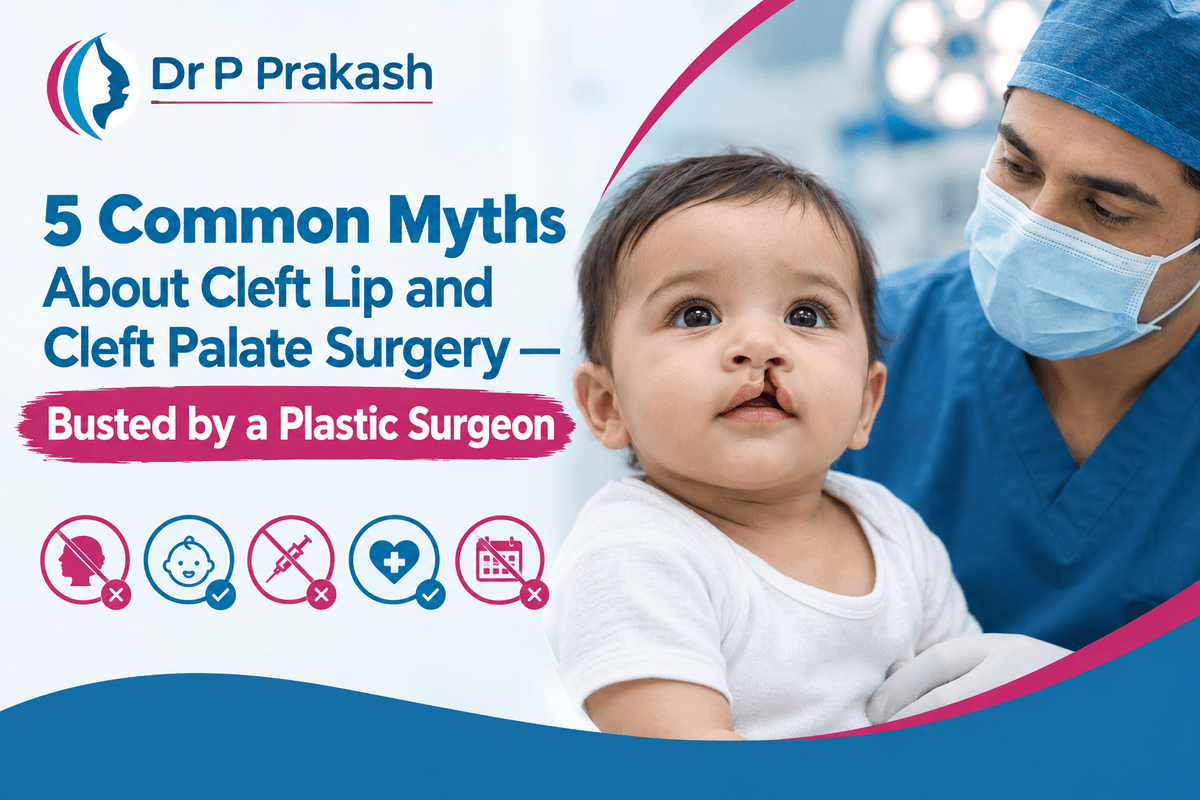
5 Common Myths About Cleft Lip and Cleft Palate Surgery — Busted by a Plastic Surgeon
By Dr. P. Prakash | Plastic Surgeon, Hitech City
When Fear Is Built on Misinformation
Every day, parents across Hyderabad receive a diagnosis that stops them in their tracks: their child has a cleft lip, a cleft palate, or both. The questions come quickly — Will my child be okay? Is surgery even safe? Will they speak normally? Can this wait?
What makes this moment harder is the flood of misinformation that often follows a diagnosis. Well-meaning family members share half-truths, online searches turn up contradictory advice, and old cultural myths add unnecessary fear and stigma.
The result? Families delay or second-guess care that their child genuinely needs — and at an age when timing matters.
As a plastic surgeon based in Hitech City, I see this pattern often. This blog addresses five of the most common myths I encounter about cleft lip and cleft palate surgery, and replaces them with clear, clinically grounded facts.
The Direct Answer: Cleft Surgery Is Safe, Staged, and Medically Necessary
Let's be clear about one thing first: cleft lip and cleft palate are not merely cosmetic conditions. Babies born with cleft lip and/or palate often struggle with eating, breathing, and speech development. Surgery is not optional — it is a functional necessity.
The good news is that surgery to fix cleft lip and cleft palate is generally very safe. The process is planned, phased, and tailored to each child's specific anatomy and overall health. Understanding what surgery actually involves — versus what myths claim — is the first step to making confident, informed decisions for your child.
5 Myths About Cleft Lip and Cleft Palate Surgery — And the Facts Behind Them
Myth 1: "It's Just a Cosmetic Problem — Surgery Can Wait"
BUSTED.
This is perhaps the most dangerous myth of all. Clefts are far more than an aesthetic problem — they can lead to difficulties in feeding, speech, hearing, and overall development.
Cleft lip and cleft palate can cause problems with feeding and growth and development, which is why it is important to correct them with surgery while a child is young.
Delaying surgery doesn't spare a child from difficulty — it can actually compound it. Early intervention is not just advisable; in most clinical contexts, it is essential.
Myth 2: "Everything Can Be Fixed in One Single Operation"
BUSTED.
This myth leads many parents to expect a quick, one-time fix — and then feel blindsided when their surgeon mentions a phased plan.
Many people believe cleft lip and/or cleft palate can be repaired in just one surgery, which is nearly never the case.
Here is how the treatment typically unfolds:
- Repair of the cleft lip is generally performed around three months of age, when the child is strong enough and the risk of anaesthesia has diminished.
- A cleft palate is usually repaired with a surgery called palatoplasty when the baby is 10–12 months old.
- After surgery, many children with cleft lip and/or cleft palate may require additional orthodontic procedures, speech therapy, and other treatments, which vary based on the patient, the cleft type and location, and other individual factors.
Each stage serves a distinct purpose, and the overall plan is built around what is safest and most beneficial for the child at each point in development.
Myth 3: "Children with Cleft Lip or Palate Will Never Speak Normally"
BUSTED.
Children born with cleft lip and palate can speak. The relationship between cleft palate and speech is real, but it is manageable with appropriate and timely intervention.
In a cleft patient, the levator veli palatini muscles are separated and oriented improperly, leading to air or liquid escape into the nose every time they speak or swallow. Palate repair surgery addresses this directly.
Many children benefit from speech therapy after cleft lip and palate repair, especially if they had significant speech issues before surgery. With surgery completed at the right age and supported by speech-language therapy, most children develop functional and intelligible speech. Every child's progress depends on individual clinical factors, and outcomes are discussed in detail during consultation.
Myth 4: "Cleft Surgery Is Extremely Risky and Dangerous"
BUSTED.
No surgery is without risk — and a responsible surgeon will never pretend otherwise. However, characterising cleft surgery as extremely dangerous is an overstatement that frightens families away from care their children need.
Known risks of cleft lip and cleft palate repair include anaesthesia risks, bleeding, infection, damage to deeper structures, irregular healing of scars, and the possibility of revisional surgery — all of which are discussed openly before any procedure.
That said, surgery to fix cleft lip and cleft palate is generally very safe. The decision to proceed is always made after a thorough individual clinical assessment, weighing each child's health, age, and specific anatomy. An informed conversation with your surgeon is the right starting point — not fear.
Myth 5: "A Cleft Is Caused by Something the Mother Did During Pregnancy"
BUSTED.
Cultural myths linking cleft formation to a mother's behaviour during pregnancy — such as going outside during a solar eclipse or using a knife — are completely without scientific basis. Such claims are false and superstitious. Right now, there is no way to 100% prevent the formation of a cleft in an unborn child.
Cleft lip and palate are congenital conditions with a complex origin. Genetic predisposition — including a family history of clefts — can increase the risk. Some clefts are also associated with genetic syndromes. No parent is to blame, and no amount of guilt will change the facts. What matters is prompt, appropriate medical care.
Clinical Context: What the Evidence Says
Cleft lip and palate is a condition that affects approximately 1 in 700 live births globally, and it can present across a wide spectrum of severity and type.
Cleft lip forms due to failure of nasal and maxillary prominences to fuse during weeks 5–6 of embryonic development; cleft palate forms due to failure of palate fusion during weeks 5–12.
It is important to work with a care team experienced in treating children with cleft lip and palate, because management extends well beyond a single surgical procedure. It involves coordination between the plastic surgeon, paediatrician, speech therapist, orthodontist, and in some cases, an ENT specialist — all working together over the course of the child's development.
The American Society of Plastic Surgeons recognises the goal of cleft lip and/or cleft palate repair as creating an end result with normal closure and no future issues for the patient.
Frequently Asked Questions (FAQ)
Q1: At what age should cleft lip surgery be done?
Cleft lip surgery is typically performed at three months of age or older, under general anaesthesia, and usually involves an overnight hospital stay. The exact timing is determined by the child's weight, overall health, and the surgeon's clinical assessment. Early surgery supports better feeding and developmental outcomes.
Q2: Will my child need more than one surgery?
Most likely, yes — and this is entirely normal. Surgery to repair a cleft lip and cleft palate typically begins when a child is three months old and continues through the teen years. Some children may need additional surgeries as they get older, including speech surgery if they develop speech problems even after the palate has been repaired. Your surgeon will map out a staged plan specific to your child.
Q3: Can a cleft palate affect my child's hearing?
Yes, it can. Children with cleft palate have a higher likelihood of middle ear problems, including fluid build-up, which can affect hearing. This is why regular ENT assessments are typically part of the broader cleft care plan. Early identification and management of hearing issues supports speech development significantly.
Q4: Is cleft lip and palate surgery available for children in Hitech City and nearby areas of Hyderabad?
Yes. Families from Hitech City and surrounding areas of Hyderabad can consult with a qualified plastic surgeon locally for evaluation, surgical planning, and staged treatment. Early consultation — ideally shortly after birth — allows the care team to prepare a structured treatment timeline suited to each child's clinical needs.
Q5: What happens after cleft palate surgery in terms of recovery?
After cleft palate surgery, your child will have stitches on the palate where the cleft was repaired. There will be some swelling at the surgery site, which diminishes substantially within a week. Many infants also show signs of nasal congestion after surgery. Feeding instructions and post-operative care guidelines are provided by the surgical team, and follow-up appointments are essential during the healing period.
The information in this blog is intended for general awareness only and does not constitute medical advice. All surgical decisions should be made following a thorough individual clinical assessment with a qualified plastic surgeon.
Visit Us
Visit Dr P Prakash to discuss your care. We're here to help you and your family.
Dr P Prakash
Hitech City
Phone: +919676602244
Website: drprakashplasticsurgeon.com/
Google Maps: https://www.google.com/maps/place/?q=place_id:ChIJBwEziGGTyzsRnshkGOgQAaY
Email: drprakashplasticsurgeon@gmail.com